Friday, January 14, 2022

Serenity of Winter in Bukhara

I think I fell in love with this city, eventhough we came in the begining of winter, when lots of attractions weren't there. The serenity that offered in every corner of the city, something that I could never erase from my memory. Snow was falling, when our train almost reach Bukhara, it took around an hour an a half from Samarkand. We reached Bukhara almost daytime, but I always think that we came early in the morning, with the snow falling.


I remember I was very tired, since I can't sleep the whole night, after emotionally drained in Samarkand. Our host already arrange taxi to pick us up from the station, and we decided to take a rest for 2 hours, before we explore the city.
But, it was very cold that day, just like I wrote before, the city seems choose to go back to sleep, it was very quiet, and not many people wandering around, eventhough we stay in the center of old city, tourists area.


We just walk for about 300m, to our first object, landmark of the city, Kalyan mosque and the city landmark, Kalyan Minaret, 48 meters tower that built during Karakhanid dynasty, in 1127 not only for adzan, Muslim's calls for 5 time prayers, it's first used by the warriors as the surveillance tower, since the mosque was built during 16th century. Kalyan Minaret was one of the tower that Gengis Khan ordered to be spared during his Bukhara conquest, a hundred years after it was built.
We enter the mosque, and feel a bit woeful, that it is too quiet for such a grande mosque. I compared with Ampel mosque in my hometown, that was built on 1421 that always full with pilgrimages from all over the country.


The second object that we visited is just in the opposite of the mosque, Mir-i Arab madrasa, it was the only madrasah, Islamic "college" allowed to operate in the Soviet era throughout the relm, and still actively use at the present time. We only visit the front area, and can see few students inside, in fact, this madrasa is the only old building that still has many lights on, on our way back to our guest house. It has a typical architectural design with madrasa in Samarkand. In fact, almost all the old buildings in Uzbekistan are similar in design, with a glazed mosaic fancy tiles, a time consuming and expensive decorative treatment, that popularized under Timur's rule.


It's almost 4pm, we haven't had our lunch, so we decide to stroll along the old city to find a restaurant written in a blog that I read, and of course food in Uzbekistan never dissappoint me. It's the road that we've through along the way, former bathhouse, former bazaar, and it's now used by souvenirs traders, really pulled my mind back to the silk road era. I can imagine the traders stopped by in a caravanserai, finding a place to take a rest after a long journey, when we pass the ruins of an old caravanserai.

After finishing our lunch, it's almost sunset, husband suggesting to find Nasrudin Khoja statue, turns out it was located next to Lyabi Hauz area. Every afternoon when we just hangout in a small garden near Lyabi Hauz, while listening to the birds chirping. I just imagine, the crowds around this old Plaza, It was such an amazing scenes that keep playing in my mind.


Nasrudin Khoja was a famous Mullah, an honorific title for Sunni muslim clergy, he appears in so many stories, he often told as a witty, wise, and often as a fool, his stories usually has a subtle humor, but also full of wisdom.


Lyabi Hauz, according to its name is a"at the pond" or "at the reservoir", it was the reservoir where the professional water-carriers took the water through the bevelled steps of the hauz, fill large letaher bags of water and deliver it to the wealthy clients. The complex are surrounded with Nadir Divanbegi Khanagha, government post equivalent to Minister of Finance, The Nadirdivanbegi madrasa, that supposedly built as a caravanserai, but the Khan, Imam Khuli Khan commended to use it as a madrasa and his religious propietery.
To the north of the hauz, there is Kukeldas madrasa, one of the largset in Central Asia, and to the south of the square was the Jewish quarter of the old town, unfortunataley we didn't explore it further. It's already dark, and the winter gave extra serene, if you couldn't say sleepy ambience of the town. 
Eventhough, we still tried to find midnight snacks in a store on the corner of the oldtown alley, before going back to our guest house.

The next morning, when we had breakfast in the guest house, the lady that served, told us about The summer palace, and she played tourism video of Bukhara. So that day, we decide to visit it, and ask her to arrange the taxi for us. It was still very cold, and we barely seen tourists everywhere, just a group of Uzbeks from other city. 

Sitorai Mokhi Khosa Palace, "Stars meet the Moon Palace", was the newest old building that we visit, it was built in 1911 by Nasrullah Khan, and finished by the last emir of Bukhara, Alim Khan in 1917. The name of the palace, was dedicated to his dad, Nasrullah Khan's wife, who died when giving birth to their child. Her name was Sitorabony, and Nasrullah Khan loved her beauty to the moon. We met new friend there, she is working there, she came to me and told me that she wants to guide us to explore the palace, she told me that we are her guests, we reminded her about Indonesia, where she ever visit for study. I was really happy, her story was amazing, how she explained every corner of the palace.
Sitorai Mokhi Khosa Palace, is half Russian and half Bukharan style, that symbolizes the straddle of a man and a society trying to reconcile 2 polar opposites.


We spent almost half of the day in the palace, the girls were very happy feeding peacocks in the palace's yard, Maxie, our guide, told us that before there were elephants too, that brought from India.


We head back to the guest house, take a short break, and continue our exploration, once again we go to the Kalyan mosque direction, but we continue to the Ark Fortress, is the oldest structure in Bukhara, it's a town in a town. Archeologists believe, it was first built between 5th and 6th century AD, there were Zoroastrian fire temple, administrative areas, and guradroom, with the main functions as a fortress. On 713 AD, when the Arabs conquered Bukhara, they built first Bukharan mosque on top of the ruins of Zoroastrian temple. Emporiums rose and fall, so did the Ark Fortress, that witnessed the changing of the rulers, the Samanids, Karakhanids, Karakhitai, and also Khorezmshah. The present form dated on 16th century, under the Uzbek Syaibanidz, the Ark not only grown to the house of the Emir, but also the whole range of the government. It was 80% destroyed during Bolsheviks revolution on 1920.
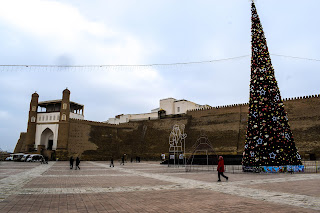


On our last day in Bukhara, we spent to explore the opposite part of the Ark fortress gate. The first building that catch our eyes was Bolo Hauz mosque, a classic simple mosque of Central Asia, that were built in 1712 for the winter building, small minaret constructed in 1917. The mosque is still actively used until today.


From the Bolo Hauz mosque, we continue to visit Imam Al Bukhari memorial museum, it's one of the greatest Islamic scholar that published the collections of Prophet Muhammad's hadiths. The museum was open in 2001. It located across Chasma Ayub, that believed as a mark where Prophet Ayub (Job) struck the arid ground, and a spring of pure drinking water miraculously burst forth.
Not far from the area, in the same complex of Samani park, we could find Ismail Samani mausoleum, completed in 905, it is the town's oldest Islamic monument. Ismail Samani was the founder of Samanid dynasty, that ruled Bukhara between 875-999 AD.


The Samani Park itself is an interesting place to enjoy and spend the day, especially on our last day in Bukhara, the sun started to show itself.  We walked back to the fortress, enjoying Bukhara Registan, renting a quad bike, and bike around the fortress. Went to the Post office to send some postcards to friends, and of course ourselves.


Bukhara, is our longest stop during our journey to Uzbekistan, but still we couldn't visit every corner of it. Eventhough the buildings here were not as fancy as the one we visited in Samarkand, Bukhara offers serenity and its unique beauty. With around 150 madrasas around the city, and it's role as one of the big town during Silk road era, no wonder so many great names in Science, knowledge and religion were born here, Ibn Sina, Al Biruni, and Imam Al Bukhari. 
Spending time in Bukhara, getting lost in the small alleys, would have special place in our memory.


Tuesday, January 4, 2022

Samarkand, Crossroads of Culture

It's been more than 1 weeks since I wrote about our traveling journey in Uzbekistan. There are 2 other cities that I need to write, but since these 2 cities are too magnificent for me to just write just based on our experience. I feel the urge to read more and more about the history of these 2 great cities. The history that amazed me, the long journey of life.

I was awe-inspired since the first time I set my foot in front of Registan Square, the grande buildings monuments of human civilization for centuries. in 2001, UNESCO added the city as one of World Heritage List, Samarkand - Crossroads of Cultures


We arrived at Samarkand around 11 am, our guest house host picked us at Samarkand's train station. We took Afrosiyob from Tashkent, around 300 km journey for 2 hours using the fast train. It costs 200.000 so'm, or only 18USD, or 50 AED per person for the VIP class. We got free breakfast and only 12 seats in our wagon. A very comfortable journey.


Outside the train stations, you will find lots of taxi drivers offering Samarkand tours, we don't have time to check for the price. Our guest house host already picked us. Not far from the stations' gate you' ll see tram, one of public transport in Samarkand, but it doesn't operate around tourism area. Samarkand is quite busy city too nowadays, traffic jam in the main roads, developments of the roads took part as the cause of it.

Our guest house is a bit off the city, around 8 km in the suburbs area, but it's only 17 minutes to travel to the tourism objects using taxi, or around 30.000 so'm one way. Once we reach the guest house, we were served with Uzbek's tea, qora choy, or black tea. Tea is very common here in Uzbekistan, you can find it everywhere, they will ask you, qora choy, ko'k choy? black tea or green tea? After few days, you'll become addicted in to it, especially on cold weather, and you barely found hot chocolate anywhere.


The name Samarkand was derived from old Persian words, asmara ("stone", "rock") and from Sogdian qand ("fort" or "town"), Samarkand literally means "stone fort" or "rock town". The city has long been a central point of trades across the region, it held central position on the Silk Road between China and The West. Samarkand was also home for diverse religions, Zoroastrianism, Buddhism, Hinduism, Manichaeism, Judaism, Nestorian Christianity, and when the armies of Ummayyad Chaliphate under Qutayba ibn Muslim captured the city at 710 AD, much of the city population converted to Islam.

Numerous great emporium was ruled Samarkand through the span of time, Alexander The Great was conquered Samarkand in 329 BCE, Sassanian Empire from Persia, Turkic Khaganate, and Samarkand was under patronage of Ummayyad and Abbasid Caliphate, and then replaced by the Samanids Empire. Continued by the Turkic Qarakhanid Dynasty, and conquered by Mongolian, Gengis Khan on 1200 AD until 1370 AD, when Amir Timur (Tamerlane) starting the Timurid Empire.

Most of the sites that we visited during our trip are the heritage during Timurid Empire, you can seebig Timur statues sits in the center of the city, as if he's watching and witnessing Samarkand up until now.


After short rest, 1pm we start our journey to the old city, our host ordered a taxi to take us to Registan. After we cross the street, and walk through the front site of the Registan, we were silent for a moment, four of us was just jaw dropped watching 3 big buildings in fornt of us. The old buildings that invite us to explore what's behind the wall. 


The Registan, it's the city square of Samarkand, was starting developed by the grandson of Amir Timur, Ulugh Beg. Consists of 3 buildings, Ulugh Beg madrasah, Sher Dor madrasah, and Tilla Kori madrasah. I was amazed by the passions of Ulugh Beg for science. He also built an enormous observatory, that had Fakhri sextant with diameter of about 36 meters, to increase the accuracy of his observations. He published Zij-i-Sultani of 994 stars, one of the greatest stars catalogue, one of the most original of the middle ages. You'll feel thrown to the magnificent era where lots of intellectuals gathered to study and discuss. We really enjoyed our visit there, we hired a guide for 200.000 so'm that explaining about the sites for around 45 minutes, and after that we re-explore the sites until sunset. It was incredible place, we saw many couples took pre-wedding photographs around the area. But lots of souvenirs vendors inside the sites just make our visit a bit uncomfortable.


We continue to explore Samarkand the next day, our host told us that Imam Bukhari mausoleum is near our guest house. So we decide to start our exploration from there. Imam Bukari is one of the greatest Islamic scholar born in Bukhara, he compiled hadith collections Shahih al Bukhari. Unfortunately we couldn't enter the site, it is in the development process to be built as one of pilgrimage center, and I'm sure it will attacts many moslem to visit. It's rain when we visit the area, the road were muddy because of the construction project, and our taxi driver told us about the apples farms that during winter we can only saw the dried branches, along the way to Imam Bukhari mausoleum.


We didin't realize that day journey would drain our energy, at least for me it's also drained me emotionally. The whole day, weather was gloomy, dark clouds with forecast of snowfall, and we visited lots of mausoleum, a.k.a graveyard or burial sites. From Imam al Bukhari mausoleum, we drove back to the city, to Gur-e Amir, it is Amir Timur Mausoleum, yes, it is graveyard of Amir Timur. For me and husband , who loves to watch historical drama and movies, we're a bit surprised, to find another side of history. We used to know Amir Timur's name for the antagonist part in the story, but we learnt about his great legacies here, in Uzbekistan.


From Gur-e-Timur we moved to Registan area, to explore another sites, we took a walk around 1 km, and enjoy strolling around the city. Made a short stop for the street food, enjoy the cold weather, and a bit rain. It was so great.

Reached Registan area, we walk pass the Registans to the park besides, where we can find statue of the first president of Uzbekistan, Islam Karimov. I think, it's one of the place where locals also enjoying the parks, you'll see quadcycle bike rental, street vendors, and people walking around. The heritage sites stretches around 2 km, with many sites to visit, including Siyob Bazaar, it was closed during our visit.


We visited, Bibi Khanym mosque, a gigantic mosque that built during the reign of Amir Timur,it originally had about 450 marble columns, which were hauled there and set up with the help of 95 elephants, that brought by Amir Timur from Hindustan. But, the mosque already has problems from the beginning of the construction, so it needed restorations many times, until it stopped by Abdullah Khan Ozbeg, ruler from Syahbanids Dynasty , Khan of Bukhara in the late of 16th century. The mosque starting to ruined and collapsed, and re-restored in 1974, by the government of Uzbek-SSR.
On the opposites of the mosque, we can find Bibi Khanym mausoleum. Bibi Khanym was Amir Temur's favorite wife.


We ended our strolls in Shah-i-Zinda, I was thinking that it's a Royal Complex, since it was written as Shah-i-Zinda Ensemble. Turns out it is a burial complex since 11th century. The dark clouds that hang in the sky, really add depressing ambience. What I'm impressed is, the burial complex is still exists and used up to now, we saw lots of modern burials around the complex. 


When we had breakfast in the guest house, we talked with other guests there, they were Uzbeks, and they asked us, why we travel during winter. A lot of tourist attractions isn't operating during cold days, but we didn't found any crowds during our visit, it's an advantage, since the pandemic still haunt us. But we missed few things, like the Siyob Bazaar.
Overall, it was a great trip there, honestly it made me wants to read and get more informations about Uzbekistan, and makes me want to explore another country in Central Asia.

Saturday, December 25, 2021

Traveling in Uzbekistan Based on Our Experience


Before I write more about another cities that we visited during our winter holiday, I would like to write about our traveling experience in Uzbekistan. I want to share all the pros and cons that we faced during our trip on winter there.

Winter in Uzbekistan is mild winter, many areas got snow, but it's not as thick as our previous experience in Turkey, also we went at the beginning of winter. Even the ski resort hasn't got thick enough snow to start their ski season. We are fully ready with our winter attire, but at some times we didn't need to fully wear it. So make sure you check the winter forecast before you go, we were freezing in Bukhara, because of the wind with a little snow fall, but in Tashkent, we prefer to wear our sneakers and put off our thermal wear.

Internet connection, hubby brought a mifi and bought a local number and fill it with data package, so 4 of us can have internet connection through it. But, we can't use the number for calling since we don't put it in our phone.

Transportation, there is car rental available in Tashkent, but since hubby too lazy to adapt with the traffic, and we expect snowy road, we did't rent any. We decided to use taxi, but beware the car size in Uzbekistan mostly are small, it's different situation with UAE, where we resides. Most of cars also use methane as their power supply, so the baggage size is getting even smaller, you can find a big methane tank there.

When we headed to airport and try to get bigger taxi, we got Chevrolet Optima 😅.


Taxi is easy to get in all cities that we visited, in Tashkent we use Yandex apps to hail taxi, it's easy and you don't need to have local number, as long as you have internet connection, it works very well. And you will pay based on the taxi meter in driver's app. 
In Bukhara and Samarkand we prefer to hail taxi on the road, since it's easier to recognize which one the taxi are, they put sign on top of the car. And you can bargain the rate, but the minimum rate is at 20.000 so'm, if we move 1-2 km. average rate is 10.000 so'm per km.
Our guesthouse host in Samarkand advise us to use Taxi Ok apps, but you need to have an active local number to use this app.

For a long distance trip, like Tashkent - Chimgan, you should bargain the taxi price before you use the service. We found our hotels are helpful enough to arrange taxi for us, except for the first time, when we took taxi from the airport, early in the morning.
Tashkent metro is very special, it's very easy to access, cheap, and historical. For me it's more than transportation, but also very interesting to get lost in it 🙆. You only need to pay 1400 so'm per person per access.

Train, we booked afrosiyob train ticket 30 days before our planned trip, it's a fast train with limited schedule, so it's fully booked very fast. If you already have itinerary arranged before 30days, you can try to contact local travel agent that will help you book the train ticket. Since hubby loves challenge, he booked everything by himself 😘. It's a good experience using Afrosiyob, fast, clean and comfortable, we tried both VIP and economy class, all good and we spent arund 10 USD - 30 USD for each person per trip, depends on the class and distance. There are another type of train, but it took longer travel time, you can check it at https://railway.uz/en/


Accomodation, we use hotel reservation apps to find the hotels. But to find hotels in Chimgan is different story, so little choice in the apps, you can check google map and see so many hotels there, so I try to search their instagram account, and contact them one by one. Mostly responding very well, but few only responded in Russians.

The payment system also another challenge, especially outside Tashkent. They usually only accept Visa or another local/Russian payment network, rarely they accept master. And if they accept, they will charge you 10% for the payment fee. Getting cash from ATM (bankomat), you'll get charged by local bank and your origin bank.

Food, the food in Uzbekistan were satisfying for me. I'm an Asian that used to eat rice everyday, and everytime I travel I used to craved for rice or instant noodles. Strangely, I don't feel that in Uzbekistan. You can find rice, bread (in every corner of the country), soups, noodles and all are seasoned perfectly.


Our family enjoy to explore new places and find out about all things about new places we visit. We will try to combine all the experiences of leisure, historical, and also try to get new knowledges during our travel. And we got more than we expected during our travel to Uzbekistan. 
While traveling there, every night I was busy try to find out about the history, since the country has a rich culture and history, and we really enjoy talked about it. Not to mention, discussion with many local people about how's life there. So make sure what you want to get from your holiday before you plan it.

The exchange rate during our visit :
1 USD = 11.000 UZS (so'm)
1 AED = 3000 UZS (so'm)


All About Me

A girl who still in search of her own cup of coffee